
Account
Pictures
Rotary Racer - Car Performance
Castle Come 2010-06-27
Results
Unfortunately not a good race. During practice, one of the drivers managed to roll the car at the nortorious quarry corner. Thankfully the car stood up to the roll very well and the driver was un-harmed (apart from some dented ego).Car Computer Log
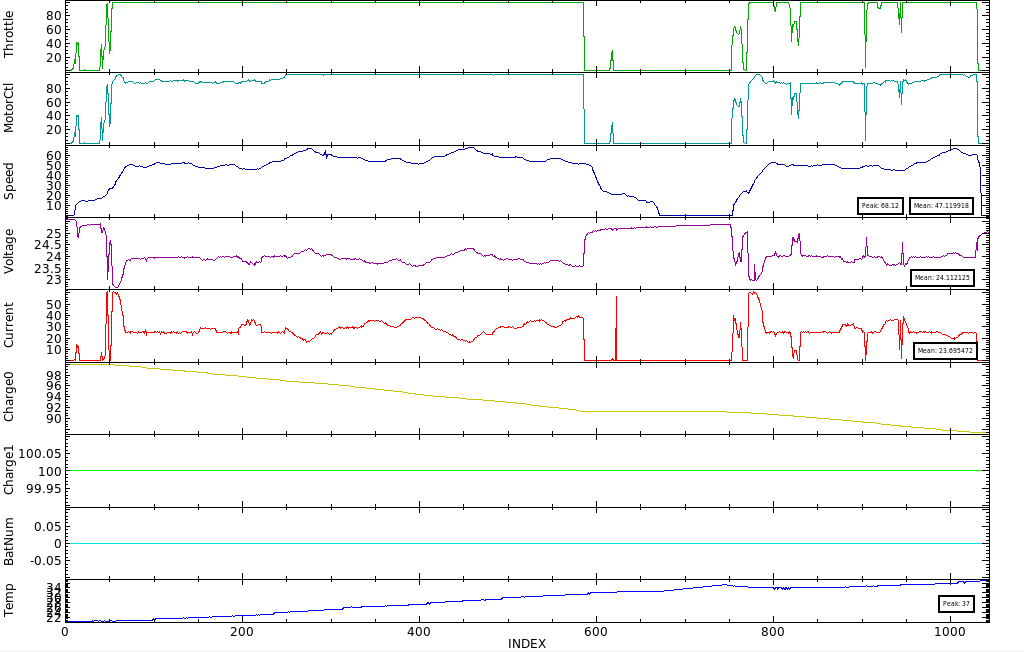
This shows the main items measured by the Rotary Racers car computer. They are:
| Item | Description |
|---|---|
| Throttle | The position of the twist grip throttle from 0 to 100% |
| MotorCtl | The motor power output setting. The Car computer sets the motor power based on the drivers throttle position, the speed of the car and the current being used. There is a software algorithm to implement this "drive by wire" system. The Car computer drives the PWM (Pulse Width Modulation) Motor Speed controller with a duty cycle proportional to this value. 0 - 100% |
| Speed | The speed of the car in Km/H calculated from the magnetic read switch pulse generator by the Car Computer. |
| Voltage | The batteries voltage under load. |
| Current | The current being taken from the batteries. |
| Charge0 | The charge left in the battery pack 0. This is calculated by the car computer using an algorithm that has been honed to match the battery discharge curves for the Yuasa batteries. It currently bases its results on the current being used from the battery. |
| Charge1 | The charge left in the battery pack 1. This is calculated by the car computer using an algorithm that has been honed to match the battery discharge curves for the Yuasa batteries. It currently bases its results on the current being used from the battery. |
| BatPack | The battery pack in use (0 or 1), the turbo button (2) and the Pitstop warning (4) . We generally change the battery pack with each driver change. |
| Temp | The Temperature of the motors casing in degrees C. |
| GPS | GPS position, speed and time together with lap position information |
| Misc | Other itmes describing the operation of the control system |
The graphs show the overall data, the actual ASCII data log files are also available, from the links below, for detailed analysis.
Notes
- The Car was RR8d. This was the cars seventh race. The only modifications since the last race was a metal plate near the motor to improve cooling flow and the movement of the GPS aerial to the top of the rollbar.
- The car was running with a 20:49 (2.45) ratio on the chain drive.
- The Castle Combe circuit is 2.977Km long and has some slight hill with generally sweeping corners although there are some tightish ones as well, but no chicanes. It is a bit bumpy in places. There was a slight wind on the day (18Km/H ?).
- The software was car18 which included average speed computation and GPS data and lap timing measurements. The Car electronics worked well and the software changes worked well. The speed measurement was fixed and the GPS worked fine.
- The first driver took the car on a 3 lap test, one of which was on full power to test gearing ratios. All went fine although he did say it was a bit bumpy.
- The next driver, who was expierienced, but not with this circuit then took out for practice at the normal power level. He did one circuit and then on the second had a problem at the sharp, almost hairpin quarry corner. The car rolled at this point while going relatively fast (about 52 KmH). From the accounts of the event, and looking at the track afterwards, we conjecture the following:
- The car was going quite fast (36.9MPH) after the downhill section of the track with the wind behind. It looks like the driver started to slow the car down in the last few seconds and it appears to have rolled while doing about 52KmH (32.5MPH). The car had gone through this section with a previous driver at 36MPH and 37.7MPH previously on the day.
- From reports and after looking at the track afterwards, there is a patch in the tarmac with some rough edges followed by a ridge of about 3cm, in the tarmac probably caused by the tarmac being pushed up by full sized cars just before the roll and on a line with the most probable line the car took.
- We think the car was cornering hard and the rear end was starting to slide when it hit the ridge. We think that this lifted the rear end slightly of the ground, allowing it to rotate and then it droped it down giving an increased friction. We think this gave enough sideways force for the car to topple.
- There were no flats on the front tyres suggesting that the front brakes had not locked up.
- On the good side the driver was completely un-hurt. His helmit was unmarked except for some small scratches on one side of the visor.
- The car protected the driver very well, especially the roll-bar. The roll bar was worn on the top with friction from the ground and had bent "forwards" by about 3cm at the top. It took the roll very well and did its job. The only other damage to the car was a buckled rear wheel (probably from when the car rolled onto it) and the top edge of the side foam was worn away. The foam probably helped by softening the rolls impact and taking the speed away with its friction on the ground. The batteries stayed in position and did not leak.
- We will need to more fully review this and do some tests on the rolling stability of the car, although its CofG is quite low already.