
Account
Pictures
Rotary Racer - Car Performance
Silverstone 2011-05-01
Results
This was the 2011 Corporate Challenge and a great 3rd place result. The car was RR8g. Since the final the car had been modified to take the new smaller batteries, the driver side flaps had been cutdown and screwed into place and the rear of the car had been extended and streamlined to take advantage of the new 2.8 meter car length.
The software had been changed to match the new batteries and a simpler laptop display added to allow easier pupil operation.
Althoug we had performed tests with the batteries over the Winter, this was the first race with them. So we planned to race with around the expected average current for the first session and pull the car in when the batteries looked like they were finished and based on that alter the average current for the rest of the race.
Car Computer Log
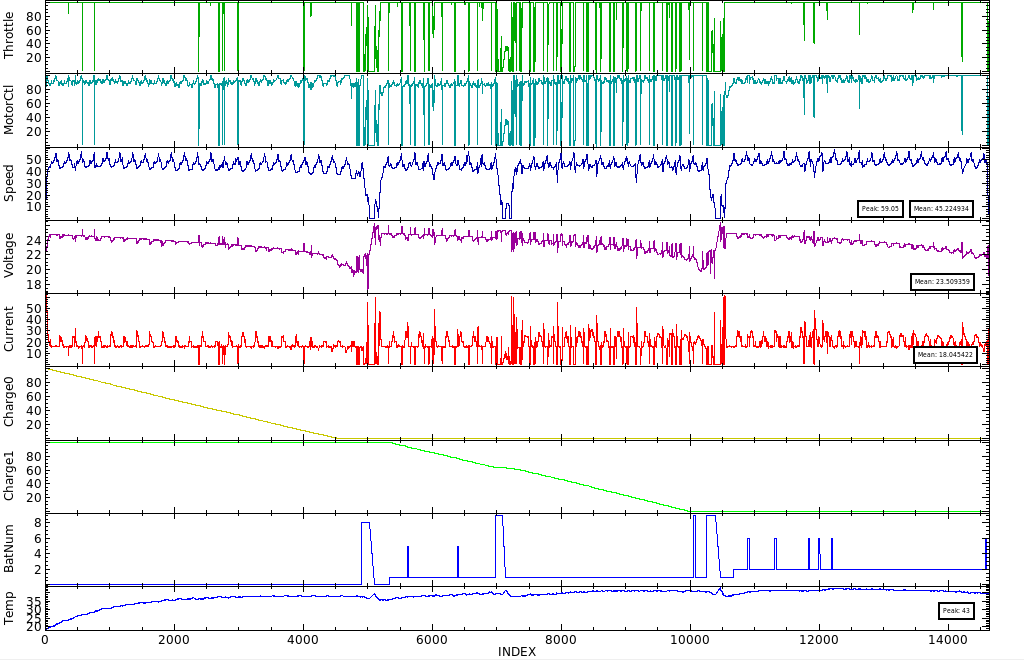
This shows the main items measured by the Rotary Racers car computer. They are:
| Item | Description |
|---|---|
| Throttle | The position of the twist grip throttle from 0 to 100% |
| MotorCtl | The motor power output setting. The Car computer sets the motor power based on the drivers throttle position, the speed of the car and the current being used. There is a software algorithm to implement this "drive by wire" system. The Car computer drives the PWM (Pulse Width Modulation) Motor Speed controller with a duty cycle proportional to this value. 0 - 100% |
| Speed | The speed of the car in Km/H calculated from the magnetic read switch pulse generator by the Car Computer. |
| Voltage | The batteries voltage under load. |
| Current | The current being taken from the batteries. |
| Charge0 | The charge left in the battery pack 0. This is calculated by the car computer using an algorithm that has been honed to match the battery discharge curves for the Yuasa batteries. It currently bases its results on the current being used from the battery. |
| Charge1 | The charge left in the battery pack 1. This is calculated by the car computer using an algorithm that has been honed to match the battery discharge curves for the Yuasa batteries. It currently bases its results on the current being used from the battery. |
| Charge2 | The charge left in the battery pack 2. This is calculated by the car computer using an algorithm that has been honed to match the battery discharge curves for the Yuasa batteries. It currently bases its results on the current being used from the battery. |
| BatPack | The battery pack in use (0, 1 or 2), the turbo button (4) and the Pitstop warning (8) . We generally change the battery pack with each driver change. |
| Temp | The Temperature of the motors casing in degrees C. |
| GPS | GPS position, speed and time together with lap position information |
| Misc | Other items describing the operation of the control system |
The graphs show the overall data, the actual ASCII data log files are also available, from the links below, for detailed analysis.
Practice Laps Data
good7prNUqYA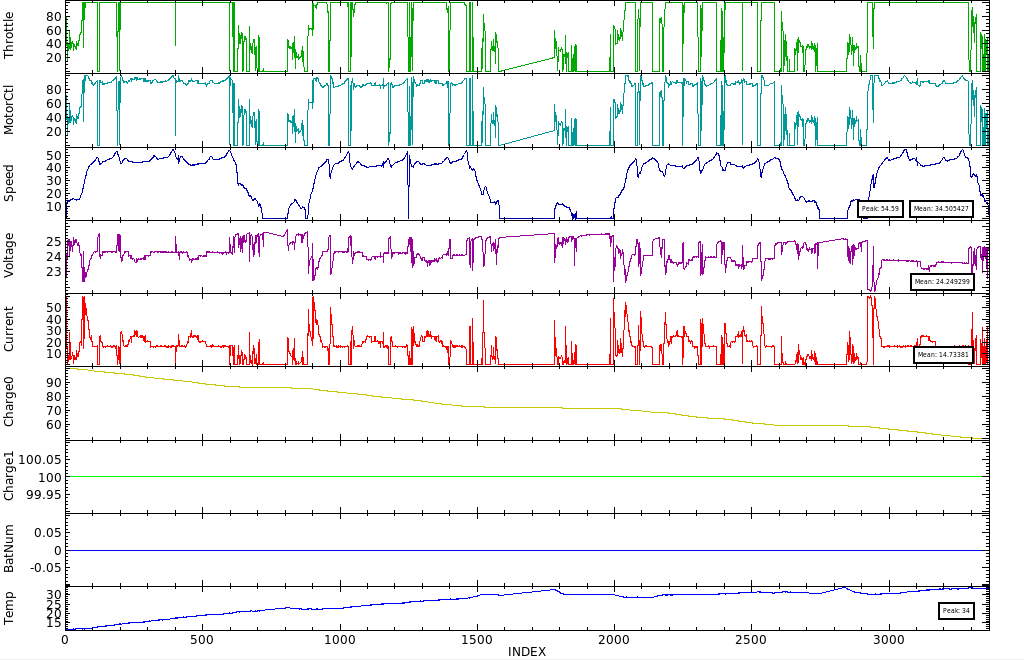
Notes
- The Car was RR8g. This was the cars eleventh race. The car had been modified to take the new smaller batteries, the driver side flaps had been cutdown and screwed into place and the rear of the car had been extended and streamlined to take advantage of the new 2.8 meter car length. The batteries were kept in insulated and warmed battery boxes.
- We used a 18:49 gear ratio after testing during practice sessions.
- The Silversone circuit is 2.637Km long and is fairly flat with sweeping corners. There was quite a wind on the day (35Km/H ?) and it was into wind on the long uphill pit straight.
- The software was car21. The Car electronics worked well, but telemetry range was severely limited within the grandstand. This showed up a fault with setting the current limit that could cause the computer to watchdog reset if a communications packet was only half recieved. This led to loss of last lap average current data sometimes.
- The battery charge calculations need to be revised now we have actual race data. The Voltage based measurement was particularly well off.
- The new laptop display worked well, but there could be improvements. Some were noted on the day.
- The Car Computers "Average Current" setting was 16.00 Amps, the Control Speed was 44 Km/Hour, this was tweaked during the race based on actual average lap current keeping it to around 18Amps.
- Drivers were: Gareth Barnaby, Dan Dando, Tom Allington and Ben Millar. The drivers drove excellently, went fast and kept out of trouble. Ben certainly took to the bulls horns having full throttle for most of his session aided and abetted by Dan increasing the power during a dice with Simple Trug :). The drivers chose to drive with 4 drivers although we only needed three on the day. Pit stops were reasonably good but could do with quite a bit more practice. Average pitstop time was: 1.48 minutes compared with 1.06 minutes at Goodwood last June.
- The motors temperature kept below 42 degrees, the reduced average current has reduced this.
- The batteries performance matched our winter battery tests quite well and worked well. They were well matched. The voltage curves are quite flat and drop off steeply when nearing 0% charge.
- We used the first two sets of batteries to their full coming in when battery voltage levels indicated. This left quite a lot in reserve for the last set of batteries. We used extra current during this stage but still had about 15% of this batteries power in reserve at the end of the race.
- An excellent first race with the new batteries and a great 3rd place result.